
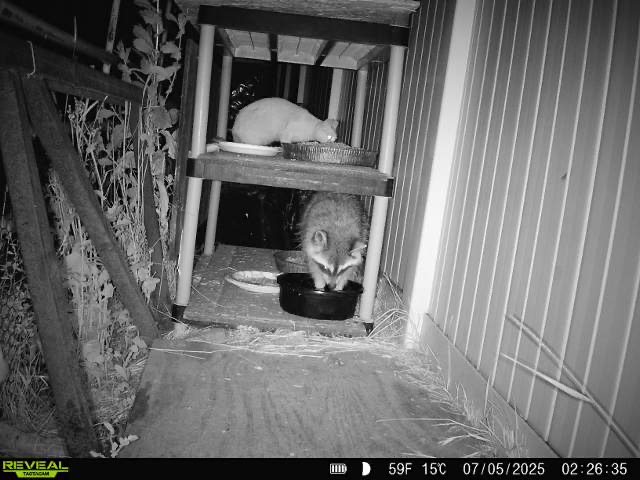
When people ask me about the challenges of feeding feral and community cats, one of the most common questions I hear is:
“But what about the raccoons?”
I get it. Raccoons have a reputation. They’re clever, persistent, and not exactly picky when it comes to food. But after caring for and feeding feral cat colonies since 2018, I can tell you this: feral cats and raccoons can coexist peacefully, if there’s enough food to go around. And I’ve got years of firsthand experience to back that up.
Raccoons Are Smarter (and Stronger) Than You Think
One of the biggest misconceptions I hear is that raccoons aren’t good climbers. That couldn’t be further from the truth. These little survivalists are excellent climbers, they’ve scaled fences, trees, and feeding stations like it’s no big deal. I’ve even seen them use teamwork, literally standing on each other’s backs to reach higher spots.
There are certainly deterrents that can help (like feeding in the early morning or using elevated platforms), but they’re not foolproof. Some colonies only feel safe eating at night, and in many cases, you’re working with limited space or accessibility.
Peaceful Coexistence Is Possible
Here’s what I’ve learned after observing multiple colonies, year after year:
When there’s enough food, the cats and raccoons don’t fight.
They either eat together, sometimes within feet of each other, or take turns. It’s not a turf war. It’s survival. And when their needs are met, they tend to respect each other’s space.
I know some people might suggest trapping and relocating the raccoons, or worse, killing them. To me, that’s not only inhumane, it’s wrong. Raccoons are simply trying to survive, just like the cats. They didn’t ask to be born into a world where food is scarce and people are afraid of them.
Compassion for All Creatures
I don’t believe in picking and choosing which animals are “worthy” of help. Compassion doesn’t stop with cats. It extends to every creature trying to make it through the night.
Of course, we do what we can to manage feeding routines and reduce food waste. But at the end of the day, the best solution I’ve found is simple: make sure there’s enough food. Everyone eats. Everyone stays safe.
What You Can Do
If you’re managing a cat colony and also see raccoons nearby, here are a few compassionate tips:
- Feed early in the morning if your cats are comfortable coming out in daylight.
- Raise feeding stations if possible, but remember, raccoons are resourceful.
- Spread out feeding areas to avoid crowding or competition.
- Offer enough food so both cats and raccoons can eat without stress.
- Never harm or relocate wildlife, it rarely solves the problem and often creates new ones.
Final Thought: Live with Compassion
Caring for community animals isn’t always easy. But it’s a privilege. Every time I watch a cat and raccoon peacefully sharing a space, I’m reminded that coexistence is possible when we lead with compassion.
Let’s be kind. Let’s be patient. And let’s remember, we’re all just trying to survive out here.

Leave a Reply